

30/10/2026
Key Takeaways
Choosing a Battery Electric Vehicle (BEV) truck should begin with an analysis of your business's actual transportation requirements, including daily driving distance, cargo weight, number of trips, and vehicle downtime.
Businesses should then select the appropriate truck type and plan the charging infrastructure together, while also evaluating after-sales support and comparing vehicle acquisition options, such as purchasing or leasing.
This approach helps reduce the risk of investing in a truck that offers impressive specifications but does not meet the requirements of daily operations.
Table of Content
BEV trucks are available in different sizes and designed for various transportation applications. A truck suitable for urban distribution may not meet the requirements of heavy-duty transportation between factories and warehouses, even if both models offer similar driving ranges on paper.
Before contacting a BEV truck supplier, businesses should therefore collect information about their transportation routes, cargo requirements, and operating schedules to evaluate which truck models can support continuous operations, as well as the charging infrastructure and support services required.
The driving range stated in a vehicle's specifications is a useful starting point. However, actual performance also depends on payload, route conditions, traffic, and electrical equipment used on board.
At the same time, a truck with a longer driving range may not always be the most suitable option if its larger battery capacity reduces available payload or increases the initial investment.
According to the International Energy Agency (IEA), evaluating electric trucks requires consideration of the relationship between battery size, driving range, payload, and charging requirements, as well as operating patterns that affect the vehicle's Total Cost of Ownership (TCO).
These considerations provide a general assessment framework for heavy-duty electric vehicles and are not specific to the Thai market.

Start by evaluating the actual total daily driving distance, rather than the distance of a single delivery trip.
Review the number of trips, delivery stops, potential additional mileage from route changes, and the periods when the truck returns to the warehouse or factory.
If the truck operates on fixed routes and returns to the same location every day, charging schedules are generally easier to plan.
For trucks operating on frequently changing routes or handling additional deliveries during the day, businesses should allow for extra driving range and verify the availability of suitable charging stations before selecting a model.
Request information on the actual usable payload capacity of each truck model and compare it with the maximum cargo weight transported per trip.
Do not evaluate vehicle size or Gross Vehicle Weight (GVW) alone, as the weight of the battery, vehicle body, and additional equipment can affect the remaining payload capacity and cargo space.
If the operation requires refrigerated bodies, enclosed cargo boxes, trailers, or lifting equipment, these requirements should be communicated to the supplier from the beginning so that the complete vehicle configuration can be evaluated.
The IEA identifies battery weight as an important consideration for transport operators, particularly those already operating close to maximum payload limits.
Select the appropriate truck size based on both cargo volume and operating environment.
Smaller trucks may offer greater maneuverability for urban transportation and delivery locations with limited space. Meanwhile, transportation between factories and warehouses may require larger trucks to accommodate heavier loads and more demanding delivery schedules.
Before making a decision, businesses should also check vehicle height, warehouse access, turning space, loading and unloading areas, and restrictions along regularly used routes.
Compare operating schedules with the periods when trucks are actually parked, such as after working hours, while waiting for cargo loading, or during shift changes.
Ask the supplier about the maximum charging power supported by the selected truck model and how long it takes to charge within the battery State of Charge (SOC) range required for your operations.
Charging time depends on the vehicle, charger, and battery level at the beginning of charging.
Therefore, businesses should not rely on a single advertised charging time when determining whether a truck can complete its scheduled trips.
If trucks will be charged at a factory or distribution center, businesses should evaluate the available electrical capacity, installation space, number of vehicles requiring simultaneous charging, and future fleet expansion plans.
Selecting trucks and charging equipment independently may result in insufficient charging capacity or bottlenecks when multiple vehicles return to the depot at the same time.
According to the IEA, charging infrastructure can be expanded in phases as the fleet grows, beginning with depot charging and adding charging options along transportation routes when necessary.
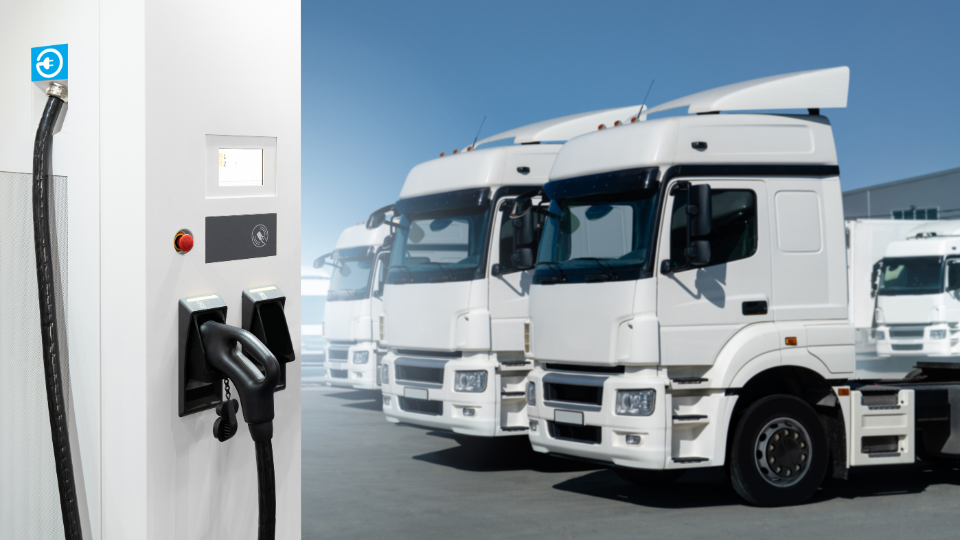
Commercial trucks are essential operating assets that must remain available according to delivery schedules.
Businesses should therefore evaluate service coverage, spare parts availability and lead times, roadside assistance, and training for drivers and maintenance personnel.
For leased vehicles, it is also important to verify whether scheduled maintenance and spare parts are included in the lease payments and who is responsible when a vehicle is unavailable due to repairs.
Request written details of both the vehicle and battery warranties, particularly the warranty period, operating conditions, and battery health assessment procedures.
These details help businesses evaluate potential maintenance costs and vehicle downtime more comprehensively.
In addition, consider the vehicle's residual value at the end of the contract, including options such as buy-back arrangements, as these conditions directly affect the Total Cost of Ownership.
|
Transportation Application |
Recommended Truck Type to Consider |
Key Factors to Evaluate |
|
Urban distribution |
Light-duty electric trucks, such as 4-wheel or 6-wheel trucks |
Number of delivery stops, parking accessibility, and total daily mileage |
|
Transportation between factories and warehouses |
Larger 6-wheel or 10-wheel electric trucks, depending on payload requirements |
Actual payload capacity, trip frequency, and charging time between shifts |
|
Material handling within factories or industrial estates |
Specialized electric transport vehicles or electric tractor units |
Required equipment, operating space, and daily operating hours |
This table provides an initial framework for selecting suitable vehicles.
The final choice should be confirmed based on vehicle specifications, cargo weight, and each business's actual operating requirements.
Once potential truck models have been identified, businesses should simulate a complete daily operating schedule.
This should include departure times, number of trips, estimated energy consumption, vehicle return times, and whether other trucks will require charging during the same period.
Based on this information, businesses can evaluate the required number of chargers, electrical capacity, and total project costs.
They should also compare different vehicle acquisition options, such as outright purchase or Operating Lease, which differ in terms of initial investment, maintenance responsibilities, and vehicle residual value at the end of the contract.
Conducting a pilot test on actual transportation routes before expanding the fleet can help verify driving range, payload capacity, charging time, and driver readiness.
Using real operating data enables businesses to make more informed decisions before committing to large-scale fleet electrification.
For businesses looking for a reliable electric truck supplier, Toyota Tsusho (Thailand) offers BEV truck solutions for urban distribution, medium-distance transportation, and operations within factories or industrial areas.
Our solutions also include support for EV Fleet planning, charging systems, and electrical infrastructure, tailored to the operational requirements of each business.
In addition, businesses seeking to reduce initial capital expenditure can consider Operating Lease solutions offered through Toyota Tsusho Group companies, helping them plan monthly electric truck expenses more effectively.
A good starting point is to prepare information about transportation routes, number of trips, maximum cargo weight, and vehicle parking locations.
With this information, our team can help evaluate suitable trucks, charging infrastructure, and financing options based on actual operating requirements.
For more information, please contact us at +66 (0)2-825-5555.
Discover more about Toyota Tsusho through our corporate introduction video and explore our other businesses.
A: There is no single driving range that applies to all BEV truck models.
Businesses should review the manufacturer's stated driving range and compare it with their actual payload, transportation routes, and number of daily trips.
For more information about driving range and charging time, read Toyota Tsusho's article, "Are Electric Trucks and Electric Buses Worth It?"
A: Not necessarily. Battery capacity should be sufficient to support daily operations, with an appropriate allowance for unexpected conditions.
However, businesses must also consider payload capacity, purchase price or leasing costs, and available charging opportunities.
If a truck can return to its depot for charging every day, the model with the largest battery may not provide the best overall value.
A: Businesses should prepare information about transportation routes, daily driving distances, number of trips, cargo weight per trip, required vehicle body type, vehicle downtime, number of trucks needed, and the proposed charging station location.
This information enables suppliers to recommend truck models and charging solutions that better match actual operating requirements.
A: The most suitable option depends on the business's investment budget, operating plans, and ability to maintain the vehicles.
Purchasing may be suitable for businesses that prefer asset ownership and have established maintenance capabilities. However, they must also manage risks associated with vehicle residual value and battery condition at the end of its service life.
An Operating Lease can reduce initial capital expenditure and make monthly expenses more predictable.
Businesses should verify whether lease payments include maintenance services, spare parts, and end-of-contract conditions.
Comparing the total costs over the contract period for both options is recommended before making a decision.
References
1. International Energy Agency (IEA). (2025). Global EV Outlook 2025: Trends in Heavy-Duty Electric Vehicles. Retrieved October 21, 2026, from https://www.iea.org/reports/global-ev-outlook-2025/trends-in-heavy-duty-electric-vehicles